
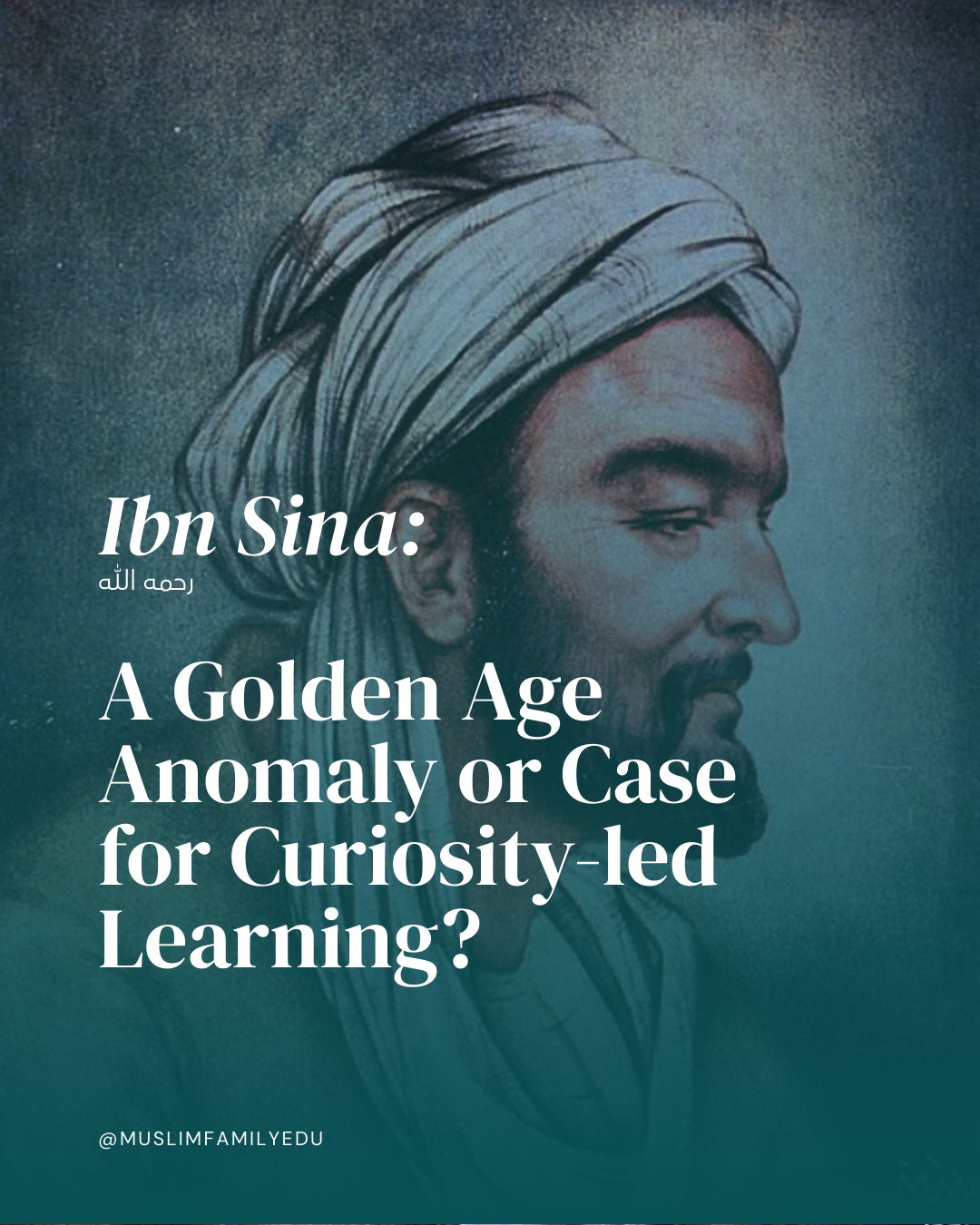
Ibn Sina is an incredible example of a person who educated himself to satisfy innate curiosity and solve real needs.
Today he is known as the father of early modern medicine, having made great contributions to various branches of knowledge and practice that are still referenced today.
When I read about Ibn Sina, what stands out to me isn’t just brilliance or productivity. It’s the approach to education.
I see the outcome of a learning culture oriented toward curiosity, depth, and personal mastery — not performance, compliance, or employability.
He followed questions
Learning was guided by inquiry. He sought answers to questions, and those questions shaped what he learned next.
It was not a by-product of learning, or treated as immaturity or distraction. It was trusted as a legitimate guide.
Learning, in this sense, was responsive and alive. Directed by wondering rather than requirements.
He learned by solving real problems
Much of his knowledge emerged from real need.
He encountered problems, drew on prior knowledge, and learned further by applying it from a very young age. Knowledge didn’t sit in isolation. It built on itself as it was used.
This matters, because learning like this doesn’t stay abstract. It becomes embodied and deepens with consequence, feedback, and responsibility.
He applied knowledge as part of learning, not after it
Application wasn’t the final step, it was part of the learning cycle itself.
Through applying what he knew, he deepened it. This is the natural learning cycle: experience, reflection, refinement. Not theory first, life later — but knowledge gained from engagement with the world.
He learned across disciplines
Ibn Sina did not confine himself to a single field.
He explored widely, and that breadth wasn’t a distraction from mastery — it contributed to it. Insights crossed disciplines. Understanding deepened through contrast, connection, and synthesis.
This kind of learning develops more than expertise. It develops judgement, perspective, and character.
He dared to contribute
Perhaps most striking is that he contributed. He didn’t wait for permission nor outsource thinking.
Today, we are conditioned into passivity — taught that contribution only counts if it is credentialed, sanctioned, or extraordinary. Everything else is dismissed before it even begins.
This narrative limits output and reshapes identity.
Ibn Sina’s story is a testament to learning that produces people who think, inquire, contribute, and grow into personal mastery.
When it is reduced to pathways, outcomes, and validation, curiosity weakens. Self-trust erodes. Contribution narrows.
Curiosity is not something we need to reintroduce — it is something that needs to be trusted.
When learning is allowed to unfold through inquiry, application, and breadth, it develops thinkers and contributors that are both competent and interested.
Ibn Sina’s story is a reminder of what’s possible when it is allowed to flourish.
Leave a Reply